Hall Effect Measurement
Phi Nanoscience Center (PNSC)
1. What is the Hall Effect?
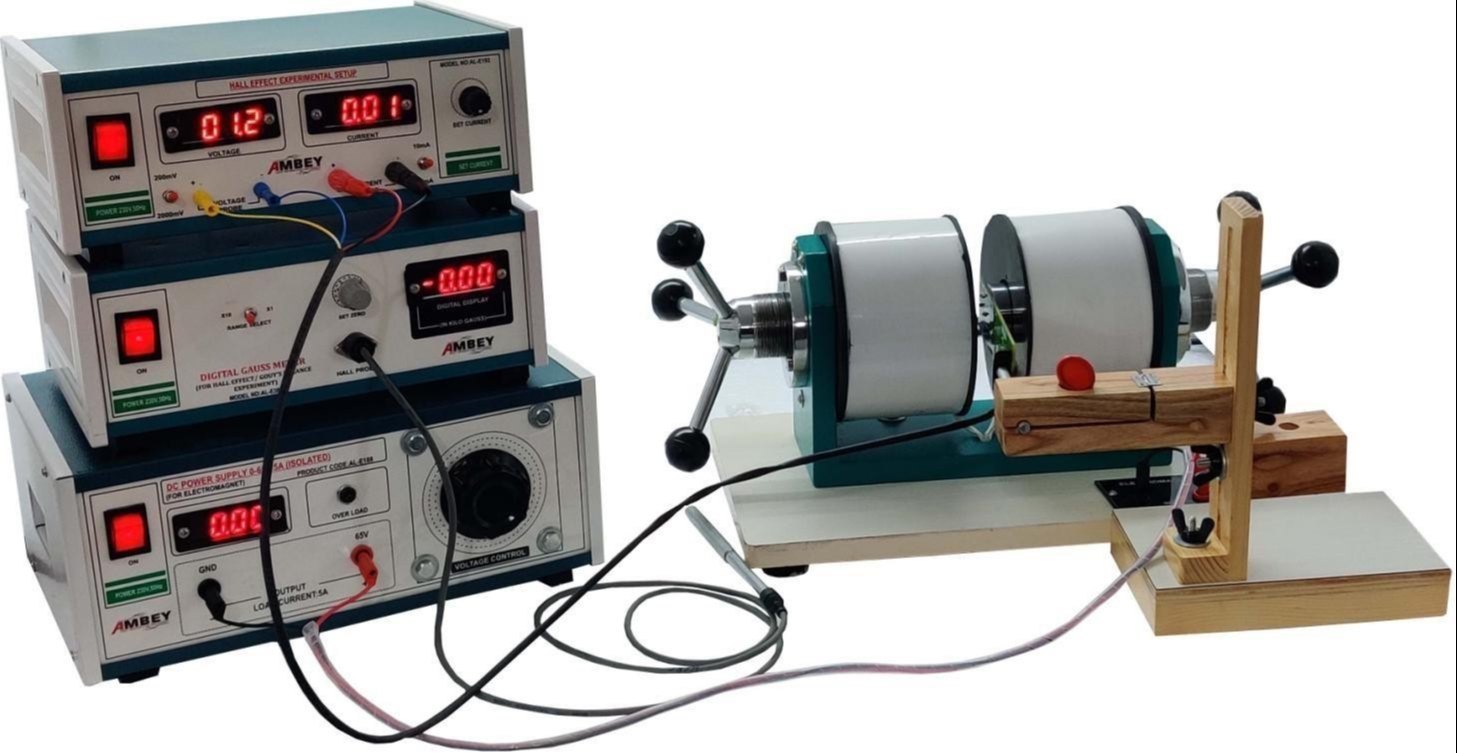
The Hall Effect is the production of a voltage difference (Hall voltage) across an electrical conductor when a magnetic field is applied perpendicular to the current flow. Hall Effect measurements are used to determine fundamental electronic properties of semiconductors and metals [1].
Key Applications in Nanomaterials Research:
- Determining carrier type (n-type or p-type) of semiconductors.
- Measuring carrier concentration (number of charge carriers per cm³).
- Calculating carrier mobility (how fast electrons or holes move in an electric field).
- Characterizing doped nanoparticles, thin films, and 2D materials.
2. Principle of Operation (Simplified)
- Step 1: A constant current (I) is passed through the sample.
- Step 2: A magnetic field (B) is applied perpendicular to the current.
- Step 3: The Lorentz force deflects moving charge carriers (electrons or holes) to one side of the sample, creating a transverse voltage (Hall voltage, V_H).
- Step 4: The sign of V_H indicates the carrier type (positive for holes (p-type), negative for electrons (n-type)).
- Step 5: The magnitude of V_H is used to calculate carrier concentration (n or p) and carrier mobility (μ) [2].
3. Information You Will Receive in Your Report
Information
How It Benefits Your Research
Carrier Type
n-type (electrons) or p-type (holes).
Carrier Concentration (n or p)
Number of charge carriers per cm⁻³.
Carrier Mobility (μ)
Measured in cm²/(V·s).
Hall Coefficient (R_H)
Measured in cm³/C.
Resistivity (ρ)
Measured in Ω·cm (from the same measurement).
Measurement Conditions
Applied current, magnetic field strength, and temperature.
4. Sample Preparation Guide
Sample Type
Preparation Method
Thin Film
Deposit the film on an insulating substrate (e.g., glass, SiO₂/Si). Electrodes must be placed at the four corners of a square or cloverleaf pattern (Van der Pauw geometry).
Bulk Solid / Pellet
Cut or shape the sample into a small square or disc. Contact four small electrodes to the periphery (Van der Pauw method).
Important Notes:
- Samples must be conductive (not highly resistive).
- For the Van der Pauw method, the sample must be homogeneous, of uniform thickness, and have no isolated holes.
- Electrode contacts must be Ohmic (not rectifying).
5. Understanding Your Results (Guide to Interpretation)
- Carrier Type:
- Negative Hall Coefficient (V_H negative): n-type material. Electrons are the majority charge carriers (e.g., doped ZnO, SnO₂).
- Positive Hall Coefficient (V_H positive): p-type material. Holes are the majority charge carriers (e.g., doped NiO, CuO).
- Carrier Concentration (n or p):
- High ( > 10¹⁸ cm⁻³): Degenerate semiconductor or metal-like conductivity.
- Medium (10¹⁴ – 10¹⁸ cm⁻³): Typical range for doped semiconductors.
- Low ( < 10¹⁴ cm⁻³): Intrinsic or lightly doped semiconductor.
- Carrier Mobility (μ):
- High ( > 100 cm²/(V·s)): High-quality crystalline material with few defects.
- Low ( < 10 cm²/(V·s)): Polycrystalline, amorphous, or defective material.
6. Frequently Asked Questions (FAQ)
Question
Answer
What is the difference between Hall Effect and conductivity measurement?
Conductivity measures how easily charge flows. Hall Effect tells you which charges are flowing (electrons or holes), how many, and how fast they move.
Can you measure Hall Effect on powders?
Hall Effect requires a continuous conductive path. It cannot be measured on isolated powder particles. The powder must be pressed into a solid pellet.
How much sample do you need?
A flat sample of at least 5 x 5 mm with uniform thickness.
Can you measure at different temperatures?
Yes, we offer variable temperature Hall Effect measurements as an add-on service.
7. References
- [1] Hall, E. H. (1879). On a new action of the magnet on electric currents. American Journal of Mathematics, 2(3), 287-292.
- [2] Van der Pauw, L. J. (1958). A method of measuring specific resistivity and Hall effect of discs of arbitrary shape. Philips Research Reports, 13, 1-9.
8. Request This Test
To request Hall Effect Measurement or any of our other services, please complete the Sample Testing Request Form.
No reviews yet. Be the first to share your experience.