1. Raman Spectroscopy
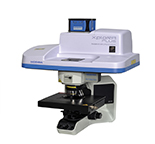
Raman spectroscopy is a powerful, non-destructive technique that provides detailed information about the molecular vibrations, crystal structure, and chemical composition of a material. It is complementary to FTIR and is especially useful for analyzing carbon-based materials, polymers, and inorganics [1].
When light interacts with a sample, most of it scatters elastically (Rayleigh scattering). A tiny fraction scatters inelastically (Raman scattering), losing or gaining energy corresponding to molecular vibrations. This energy shift creates a unique Raman spectrum—a "fingerprint" of the material [2].
Key Applications in Nanomaterials Research:
- Characterizing carbon nanomaterials (e.g., graphene, carbon nanotubes, nanodiamonds) via the D and G bands.
- Studying defects, disorder, and crystallinity in materials.
- Identifying molecular species and chemical bonds.
- Analyzing polymers, pharmaceuticals, and inorganic compounds.
2. Principle of Operation (Simplified)
- Step 1 (Excitation): A monochromatic laser beam (e.g., 532 nm or 785 nm) is focused on your sample.
- Step 2 (Scattering): Most light scatters elastically (same energy). A tiny fraction scatters inelastically (different energy), losing or gaining energy to molecular vibrations.
- Step 3 (Detection): A detector measures the scattered light and generates a Raman spectrum (intensity vs. Raman shift in cm⁻¹). The Raman shift corresponds to the vibrational energy of specific bonds [2].
3. Information You Will Receive in Your Report
- Raman Spectrum: A plot of intensity versus Raman shift (cm⁻¹).
- Peak Positions (cm⁻¹): Specific wavenumbers corresponding to molecular vibrations.
- Peak Intensities and Ratios: Used to assess crystallinity, defect density, and purity.
- Identification of Materials: Comparison with spectral databases.
- Mapping (Optional): 2D spatial distribution of chemical species (add-on service).
4. Sample Preparation Guide
Proper sample preparation is minimal for Raman, as it is non-destructive.
Sample Type
Preparation Method
Powder / Solid
Place the powder on a glass slide or in a solid sample holder.
Liquid / Colloidal Suspension
Place a drop on a glass slide or use a liquid sample holder.
Thin Film
Mount the film directly on the sample stage.
Carbon Nanotubes / Graphene
Transfer onto a SiO₂/Si wafer for best results.
Important Notes:
- Avoid fluorescent samples if possible, as fluorescence can overwhelm the weak Raman signal.
- Use a clean, flat surface for optimal focus.
- Sample preparation is minimal; most samples can be measured as-is.
5. Understanding Your Results (Guide to Interpretation)
For Carbon Nanomaterials (e.g., graphene, CNTs):
- G Band (~1580 cm⁻¹): Corresponds to graphitic (ordered) sp² carbon. Higher intensity indicates higher crystallinity.
- D Band (~1350 cm⁻¹): Corresponds to defects and disorder in the carbon lattice. Higher intensity indicates more defects.
- 2D Band (~2700 cm⁻¹): Second-order Raman band, sensitive to number of layers in graphene.
- D/G Intensity Ratio (I_D/I_G): A higher ratio indicates more defects. A lower ratio indicates higher graphitic order.
- G/2D Ratio: Used to determine the number of graphene layers.
For Other Materials:
- Peak positions are compared to databases (e.g., RRUFF) to identify materials and crystal phases.
- Peak shifts can indicate strain, doping, or changes in chemical environment.
6. Frequently Asked Questions (FAQ)
- What is the difference between Raman and FTIR? Both probe molecular vibrations. FTIR is better for polar bonds (e.g., O-H, C=O). Raman is better for non-polar bonds (e.g., C=C, S-S) and carbon materials.
- What laser wavelengths do you offer? We offer 532 nm (green) and 785 nm (near-IR). 785 nm is preferred for fluorescent samples.
- How much sample do you need? Very little. 1-5 mg of powder or a few microliters of liquid is sufficient.
- Can your sample be fluorescent? Fluorescence can interfere. We can try using a longer wavelength laser (785 nm) to minimize it.
- How long will the analysis take? 24-48 hours from sample receipt.
7. References
- [1] Smith, E., & Dent, G. (2019). Modern Raman Spectroscopy: A Practical Approach (2nd ed.). John Wiley & Sons.
- [2] Ferrari, A. C., & Robertson, J. (2000). Interpretation of Raman spectra of disordered and amorphous carbon. Physical Review B, 61(20), 14095-14107.
- Internal Source: Phi Nanoscience Center (PNSC) has extensive experience in Raman spectroscopy for characterizing carbon nanomaterials and other advanced materials.
8. Request This Test
To request Raman analysis or any of our other services, please complete the Sample Testing Request Form.
No reviews yet. Be the first to share your experience.