Test Item
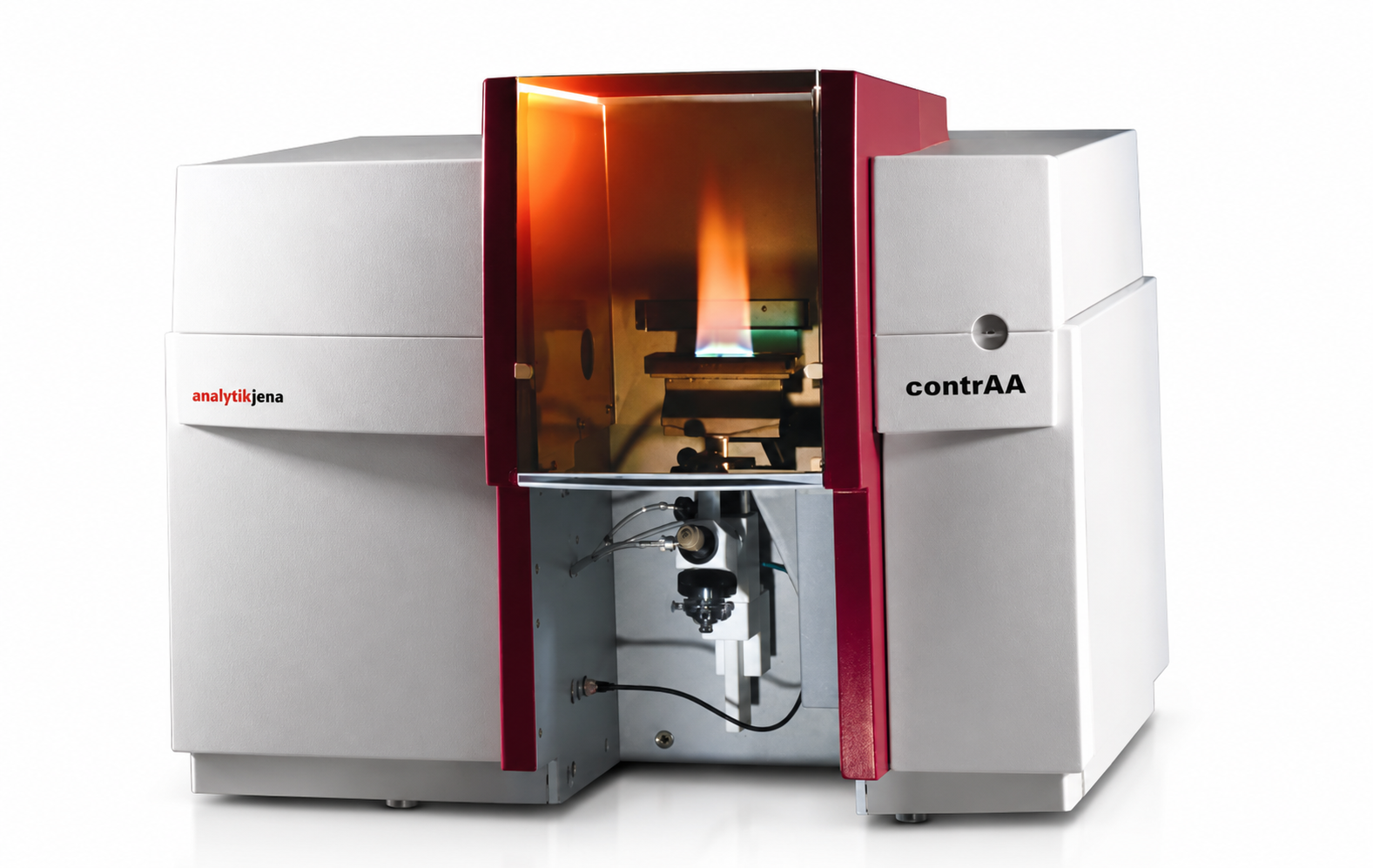
Atomic Absorption Spectrometry (AAS)
10000.00 IQD- Category : Tests
- Group : Nanotechnology Tests
Atomic Absorption Spectrometry (AAS)
Atomic Absorption Spectrometry (AAS) is a highly sensitive analytical technique used for the qualitative and quantitative determination of metallic and selected metalloid elements in liquid samples.
The technique measures the absorption of element-specific light by free atoms generated from the sample. The amount of absorbed radiation is directly related to the concentration of the target element.
AAS is widely used in environmental monitoring, nanotechnology, pharmaceuticals, food analysis, agriculture, clinical research, geological studies, industrial quality control, and heavy-metal detection.
High-Performance Elemental Analysis
Each element absorbs radiation at characteristic wavelengths. An element-specific light source, usually a hollow cathode lamp, emits radiation at the required wavelength.
The prepared sample is introduced into an atomization system, where the dissolved element is converted into free ground-state atoms. These atoms absorb part of the incident radiation, and the instrument measures the resulting decrease in light intensity.
Quantitative analysis is performed by comparing the absorbance of the sample with calibration standards of known concentrations.
Principle of AAS Measurement
The relationship between absorbance and analyte concentration can be expressed using the Beer–Lambert relationship:
A=log10(I0I)A=\log_{10}\left(\frac{I_0}{I}\right)Where:
- AA is the measured absorbance.
- I0I_0 is the initial intensity of the incident radiation.
- II is the transmitted radiation intensity.
Within the validated linear range, the measured absorbance is proportional to the concentration of the target element.
Main AAS Techniques
The available measurement technique depends on the instrument configuration and installed accessories.
Flame Atomic Absorption Spectrometry
Flame AAS uses a flame, commonly air–acetylene or nitrous oxide–acetylene, to convert the sample into free atoms.
The liquid sample is aspirated through a nebulizer, converted into a fine aerosol, mixed with fuel and oxidant gases, and introduced into the flame.
Flame AAS is suitable for:
- Routine metal analysis.
- Moderate and relatively high element concentrations.
- Rapid analysis of multiple liquid samples.
- Environmental and industrial quality control.
- Determination of metals in digested solid samples.
Graphite Furnace Atomic Absorption Spectrometry
Graphite Furnace AAS uses an electrically heated graphite tube to atomize a very small volume of the sample.
The programmed heating sequence normally includes:
- Drying.
- Pyrolysis or ashing.
- Atomization.
- Tube cleaning.
This technique offers greater sensitivity than conventional Flame AAS and is suitable for trace and ultra-trace elemental analysis.
Hydride Generation AAS
Hydride Generation AAS may be used for elements capable of forming volatile hydrides, depending on the installed accessories.
It is commonly applied to elements such as:
- Arsenic.
- Selenium.
- Antimony.
- Bismuth.
- Tin.
- Tellurium.
Cold-Vapor AAS
Cold-Vapor AAS is a specialized technique primarily used for mercury determination.
Mercury ions are chemically converted into elemental mercury vapor and transported to the absorption cell for measurement.
Main AAS Applications
- Determination of heavy metals in water and wastewater.
- Analysis of metals in soil and sediment.
- Measurement of trace elements in food and beverages.
- Analysis of pharmaceutical products.
- Determination of metals in biological samples.
- Measurement of metal loading in nanoparticles and nanocomposites.
- Determination of residual metal ions after adsorption experiments.
- Evaluation of heavy-metal removal efficiency.
- Analysis of fertilizers and agricultural products.
- Metal determination in petroleum and industrial samples.
- Quality control of metals, alloys, and raw materials.
- Monitoring metal contamination in environmental samples.
- Quantification of essential and toxic elements.
- Analysis of plant and tissue digests.
- Measurement of dissolved metals in chemical preparations.
Elements Commonly Measured
The exact elements that can be analyzed depend on the available lamps, atomization system, instrument configuration, and validated analytical method.
Commonly analyzed elements include:
- Silver (Ag).
- Aluminum (Al).
- Arsenic (As).
- Barium (Ba).
- Calcium (Ca).
- Cadmium (Cd).
- Cobalt (Co).
- Chromium (Cr).
- Copper (Cu).
- Iron (Fe).
- Potassium (K).
- Magnesium (Mg).
- Manganese (Mn).
- Sodium (Na).
- Nickel (Ni).
- Lead (Pb).
- Antimony (Sb).
- Selenium (Se).
- Tin (Sn).
- Zinc (Zn).
Quantitative Analysis
A series of standard solutions containing known concentrations of the target element is measured under the same analytical conditions used for the samples.
A calibration curve is constructed by plotting absorbance against concentration:
A=mC+bA=mC+bWhere:
- AA is the measured absorbance.
- CC is the element concentration.
- mm is the slope of the calibration curve.
- bb is the intercept.
The concentration of an unknown sample is calculated from the calibration equation and corrected for any dilution performed during preparation.
Coriginal=Cmeasured×DFC_{\text{original}}=C_{\text{measured}}\times DFWhere DFDF is the dilution factor.
Solid-Sample Concentration
For a digested solid sample, the elemental concentration can be calculated as:
Csolid=Csolution×V×DFmC_{\text{solid}}=\frac{C_{\text{solution}}\times V\times DF}{m}Where:
- CsolidC_{\text{solid}} is the concentration in the original solid sample.
- CsolutionC_{\text{solution}} is the concentration measured in the digest.
- VV is the final volume of the digested solution.
- DFDF is the additional dilution factor.
- mm is the mass of the original sample.
The final result may be reported as mg/kg, µg/g, or another appropriate unit.
Key Instrument Features
Depending on the model and configuration, the AAS system may provide:
- Element-specific absorption measurements.
- High sensitivity and analytical selectivity.
- Flame atomization.
- Graphite-furnace atomization, when installed.
- Automatic wavelength selection.
- Hollow cathode lamp support.
- Background correction.
- Automatic calibration-curve generation.
- Multiple-standard calibration.
- Sample dilution-factor correction.
- Replicate measurements.
- Statistical calculation of mean and standard deviation.
- Automatic concentration calculation.
- Digital data storage and export.
- Computer-controlled operation.
- Quality-control sample evaluation.
- Suitable operation for research and routine testing.
- Analysis of trace and major metallic elements.
Exact detection limits, linear ranges, wavelengths, flame conditions, and measurement sensitivity depend on the selected element, AAS model, atomization system, matrix composition, and analytical method.
Information Provided in the Analysis Report
The AAS report may include:
- Sample identification code.
- Target element.
- Analytical wavelength.
- Atomization technique.
- Calibration-standard concentrations.
- Calibration curve.
- Regression equation.
- Correlation coefficient.
- Measured absorbance.
- Calculated sample concentration.
- Dilution factor.
- Corrected final concentration.
- Measurement unit.
- Replicate results.
- Mean concentration.
- Standard deviation, when requested.
- Blank-corrected results.
- Spike recovery, when performed.
- Detection limit and quantification limit, when validated.
- Comparison between samples.
- Digital data suitable for Excel or statistical analysis.
- Brief interpretation of the results.
Sample Preparation Guide
Water and Clear Liquid Samples
- Samples should be homogeneous and free from large suspended particles.
- The target elements and expected concentration range must be specified.
- Samples may require acidification to preserve dissolved metals.
- Filtration may be required when dissolved-metal concentration is requested.
- Unfiltered samples may be analyzed after suitable digestion when total recoverable metals are required.
- Highly concentrated samples should be diluted before analysis.
- The sample matrix should be compatible with the selected calibration standards.
- Samples should be provided in clean, properly labeled containers.
Wastewater and Turbid Samples
- Wastewater samples may require acid digestion before measurement.
- Suspended particles must be treated consistently across all samples.
- The client should specify whether dissolved, suspended, or total metal concentration is required.
- Organic matter may require oxidation or digestion.
- Samples containing high salt concentrations may require dilution or matrix-matched calibration.
Soil, Sediment, and Geological Samples
- Samples should be dried, ground, and homogenized when appropriate.
- A representative sample mass should be used.
- Acid digestion is normally required before AAS measurement.
- The digestion procedure must be suitable for the target elements and sample matrix.
- Final digests should be clear and free from visible particles.
- The final digestion volume and original sample mass must be recorded.
Nanoparticles and Nanocomposites
- Solid nanomaterials normally require complete chemical digestion.
- The digestion method must dissolve the target metal without causing analyte loss.
- Samples should be accurately weighed.
- The final solution must be homogeneous and particle-free.
- The original sample mass, final solution volume, and dilution factor must be provided.
- AAS measures elemental concentration but does not directly determine particle size, shape, oxidation state, or crystal structure.
Plant and Biological Samples
- Samples should be properly collected, cleaned, dried, and homogenized.
- Digestion is generally required before analysis.
- Wet or dry sample mass must be clearly reported.
- Samples should be protected from contamination during preparation.
- Biological matrices may require method blanks and certified reference materials.
Food and Pharmaceutical Samples
- Samples should be homogenized before subsampling.
- Organic matrices normally require suitable digestion.
- The sample mass and final digest volume must be accurately recorded.
- Reagents should have sufficiently low metal contamination.
- Spike recovery or certified reference materials are recommended for method validation.
Adsorption Experiments
For heavy-metal adsorption studies:
- Initial and final solutions should be analyzed under comparable conditions.
- Samples should be separated from the adsorbent before measurement.
- Centrifugation or filtration may be used.
- The selected filter must not adsorb the target metal.
- Control samples without adsorbent should be included.
- All dilution factors must be recorded.
Removal efficiency can be calculated using:
Removal efficiency(%)=C0−CeC0×100\text{Removal efficiency}(\%)= \frac{C_0-C_e}{C_0}\times100Adsorption capacity can be calculated using:
qe=(C0−Ce)Vmq_e=\frac{(C_0-C_e)V}{m}Where:
- C0C_0 is the initial metal concentration.
- CeC_e is the equilibrium concentration.
- VV is the solution volume.
- mm is the adsorbent mass.
- qeq_e is the equilibrium adsorption capacity.
Important Sample Notes
- AAS generally requires the analyte to be present in a liquid solution.
- Solid samples must usually be digested before measurement.
- Samples and standards should have similar acid and matrix compositions.
- High dissolved-solid content may affect nebulization and atomization.
- Contaminated containers may produce falsely elevated results.
- Incomplete digestion may produce falsely low concentrations.
- Precipitation after digestion may cause analyte loss.
- Samples must not contain visible particles that could block the nebulizer.
- All preparation volumes and dilution steps must be documented.
- The expected concentration range should be provided when available.
- The required reporting unit must be specified.
- Appropriate blanks and standards should accompany critical analyses.
- Laboratory-grade acids and purified water should be used during preparation.
Quality-Control Procedures
Reliable quantitative analysis may include:
Reagent Blank
Used to identify contamination originating from acids, water, containers, or preparation procedures.
Calibration Blank
Used to establish the instrument’s zero response.
Calibration Standards
Solutions containing accurately known concentrations used to construct the calibration curve.
Duplicate Analysis
Used to assess the precision and repeatability of the method.
Spiked Sample
A known amount of the target element is added to the sample to evaluate recovery and matrix effects.
Recovery can be calculated as:
Recovery(%)=Cspiked−CoriginalCadded×100\text{Recovery}(\%)= \frac{C_{\text{spiked}}-C_{\text{original}}}{C_{\text{added}}}\times100Certified Reference Material
A material with certified elemental concentrations may be analyzed to evaluate method accuracy.
Continuing Calibration Verification
A standard is periodically measured during the analytical sequence to confirm calibration stability.
Understanding AAS Results
High Element Concentration
A high result indicates that the target element is present at a relatively high concentration within the analyzed solution.
Interpretation should consider:
- Dilution factor.
- Original sample mass.
- Final digestion volume.
- Sample moisture content.
- Contamination during preparation.
- Applicable regulatory or research limits.
Low or Undetected Concentration
A result below the detection limit does not necessarily mean that the element is completely absent. It means that its concentration could not be reliably distinguished from the analytical background under the applied conditions.
Results may be reported as:
- Not detected.
- Below the detection limit.
- Below the quantification limit.
- << a specified concentration.
Calibration Linearity
A high correlation coefficient indicates that the standards follow a strong linear relationship within the selected calibration range.
However, acceptable analysis also requires:
- Proper blank response.
- Suitable standard preparation.
- Stable instrument performance.
- Appropriate quality-control recoveries.
- Sample concentrations within the calibration range.
Matrix Effects
Matrix effects occur when other sample components influence atomization or light absorption.
They may cause:
- Signal enhancement.
- Signal suppression.
- Poor recovery.
- Unstable readings.
- Differences between standards and samples.
Possible approaches include dilution, matrix matching, standard addition, chemical modifiers, background correction, or an alternative atomization technique.
Common Applications
Environmental Analysis
- Heavy metals in drinking water.
- Metals in wastewater.
- Soil and sediment contamination.
- Industrial discharge monitoring.
- Groundwater and surface-water assessment.
- Metal-removal studies.
Nanotechnology and Advanced Materials
- Metal content in nanoparticles.
- Dopant concentration in metal oxides.
- Metal loading in nanocomposites.
- Dissolution and ion-release studies.
- Residual metal concentration after synthesis.
- Adsorption and remediation experiments.
Pharmaceuticals and Life Sciences
- Trace metals in pharmaceutical products.
- Metal content in biological samples.
- Mineral and essential-element analysis.
- Quality control of raw materials.
- Evaluation of metal-based formulations.
Food and Agriculture
- Essential minerals in food.
- Toxic-metal contamination.
- Metal content in plants and crops.
- Fertilizer analysis.
- Soil nutrient evaluation.
- Quality-control testing.
Industrial Applications
- Metal analysis in raw materials.
- Process-solution monitoring.
- Alloy and plating-bath analysis.
- Petroleum and lubricant analysis.
- Corrosion studies.
- Product quality control.
Limitations
- AAS normally measures one element at a time.
- Different elements require appropriate lamps and operating conditions.
- Solid samples generally require digestion.
- AAS provides elemental concentration but limited chemical-form information.
- It does not directly identify oxidation state or molecular structure.
- Detection limits depend on the atomization technique and sample matrix.
- Flame AAS may not provide sufficient sensitivity for ultra-trace concentrations.
- Matrix interference may affect analytical accuracy.
- Highly saline or viscous solutions may affect sample aspiration.
- Incomplete digestion may underestimate metal concentration.
- Contamination may significantly affect trace-element results.
- Reliable analysis requires suitable calibration standards and quality-control samples.
- Results outside the calibration range require dilution and remeasurement.
- Some elements require specialized accessories or alternative analytical techniques.
Frequently Asked Questions
Can solid samples be analyzed directly?
Generally, no. Solid samples usually require acid digestion to convert the target elements into a clear liquid solution.
Can AAS measure heavy metals in water?
Yes. AAS is widely used to determine metals such as Pb, Cd, Cu, Cr, Ni, Fe, Zn, and Mn in water and wastewater.
Can nanoparticles be analyzed?
Yes. Nanoparticles and nanocomposites can be analyzed after suitable digestion. AAS determines elemental concentration rather than particle size or morphology.
Can several elements be measured in one sample?
Yes, but conventional AAS normally measures each element separately using its appropriate wavelength, lamp, and analytical conditions.
Can AAS determine oxidation state?
No. AAS generally determines the total concentration of an element and does not directly distinguish between different oxidation states.
Can the instrument measure concentrations in ppm?
Yes. Results may be reported in ppm, mg/L, µg/L, mg/kg, or µg/g depending on the sample and analytical method.
How much liquid sample is required?
The required quantity depends on the atomization technique, number of elements, replicates, and repeat measurements. Flame AAS generally requires more sample than Graphite Furnace AAS.
Is acid digestion always required?
It is generally required for solid, biological, food, soil, nanoparticle, and complex liquid samples. Clear aqueous samples may require only preservation, filtration, or dilution depending on the analytical objective.
What information should be provided with the sample?
The following information is recommended:
- Sample code.
- Sample type and composition.
- Target element or elements.
- Expected concentration range.
- Original sample mass.
- Final digestion volume.
- Dilution factor.
- Acid or solvent used.
- Required reporting unit.
- Preparation and digestion method.
- Whether dissolved or total metal concentration is required.
Can AAS be used for adsorption studies?
Yes. It can determine the initial and final concentrations of metal ions, allowing calculation of removal efficiency and adsorption capacity.
Can AAS determine the percentage of a metal in a nanocomposite?
Yes. After complete digestion and proper calculation using the sample mass, final volume, and dilution factor, the metal content may be reported as mg/kg, mg/g, or weight percentage.